Camille Calvo
La Cambre, Bruxelles
IG @ camille.calvo
Camille Calvo, born in 1988, is a French artist designer living and working in Paris.
From 2011 to 2015, she studied at La Cambre in Brussels, within the “urban space”
workshop directed by Raymond Balaud. In 2022, she founded with Anne Sophie Matrella the ceramic workshop Bas-Relief, located in the 18th arrondissement of Paris. She teaches modelling classes there and offers technical support to other artists, whilst continuing her own research and creations.
Her artistic approach is based on the reproduction through plaster moulding of elements drawn from manual labour. She pays particular attention to forms generated by functional, standardised or repetitive gestures, particularly in the field of construction. By reproducing them in ceramic, she seeks to revealtheir aesthetic dimension. Their new sculptural status thus questions the boundaries between manual labour, craft work and artistic practice.
PVC (Processus de Variations en Céramique)
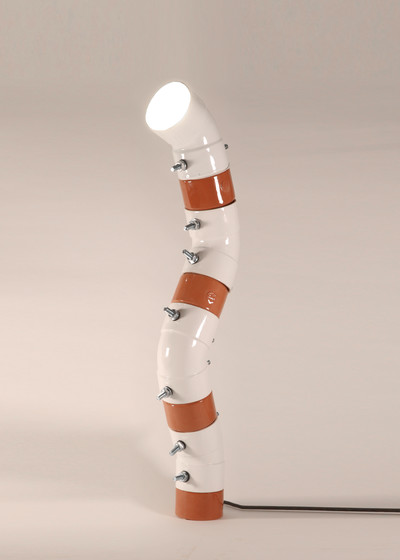
The PVC project (Processes of Variation in Ceramics) is based on the moulding and reproduction of plumbing fittings in ceramic. The PVC pipe is an emblematic element of standardised industrial production, designed to be invisible, functional and interchangeable. By reproducing it through slower, manual and repetitive processes, Camille Calvo introduces a temporal and symbolic shift between the object and its mode of manufacture. Each piece is moulded identically to become a module to which a colour is assigned, obtained from mixtures of different clays. The project is based on a participatory assembly method, conceived as a kit object. Presented in the form of detachable parts, it invites the user to construct their own configuration. The visitor is thus positioned in an intermediate position between that of the manual worker and that of the artist, engaging gesture, decision and responsibility in the fabrication of the work. By making assembly systems visible, she does not seek to conceal the conditions of production, but rather to reveal their aesthetic and constructive dimension. This approach is accompanied by a transformation of use. The pipes, evoking tubular design, are displaced from their original function towards another utilitarian and sculptural purpose: lighting fixtures.